Have fun engineering with your family

“Hey grandpa,” Grandson said, “let’s play marble track.”
“Hey grandson,” engineer Grandpa said, “let’s be engineers today and invent our own marble track. We can learn about engineering, science, and kinetic energy.”
“Yes!” grandson responded.
So grandpa and grandson went to the hardware store and office supply and found parts for a custom marble track. They used 1/2 x 1/2 inch aluminum angle, adhesive-backed magnetic tape, plastic electrical flange (blue) cut into quarters and halfs, a modified funnel, and a metal backed dry-erase white board. They went home and cut the parts (safely), applied the magnetic tape to the parts, and created their own marble track. The configurations were endless. See the video here.

Science, Technology, Engineering, and Math (STEM) can be fun. Try this project and learn about kinetic energy and momentum.
(A short short story from the author of Engineering Stories)
http://stemstories.wordpress.com

My Journey to Engineering – Part 3 “From College to Industry”

(Continued from Part 2)

“What are these photo’s you brought?” The interviewer asked during my senior year at the university. I was applying for my first engineering job and I brought pictures of the devices I had made for my dad’s cabinet shop. I think it was the photo’s that convinced the interviewer that I had good practical hand’s on engineering experience. I got the job. We packed up our little household and moved to California, or should I say ‘returned to California,’ the place of my birth.

My assignment? Design and test supporting structures for satellite payloads. Requirements? High strength to weight ratio’s with high reliability. I learned about space environments, material properties, computer aided design systems, and how aerospace companies work.

After a couple years I became a test engineer, then system safety analyst, then electronics packaging designer, then… Each assignment gave me experience in new areas of engineering. I tried diligently to learn company goals and objectives and participate in process improvement initiatives. This focus brought trust and new opportunities to serve and grow. But I wasn’t finished with school yet. I wanted a masters degree and I wanted to continue my education; I loved to learn.

I applied for graduate school, was accepted and returned to the university. I was in tears as I left the math building that warm June day. Summer on college campus was relatively quiet, but my mind was clamoring with the noise of theorems and derivations, and proofs drumming away at my confidence. “What have I gotten myself into?” I thought. I had left a good paying job and returned to college after nine years to pursue a master of science degree in mechanical engineering. The very first class I had was Linear Algebra. It was a lot of work relearning matrices and vectors, moving into linear transformations, determinants, eigenvalues and all their applications. There were times when I didn’t know if I could do it, but I kept at it and looked for ways each day to apply my new knowledge so that it would be interesting and meaningful. How meaningful could linear algebra be?

Do you remember the other day when you played a video game, or went to an animated digital movie. How did the movie makers make those complex graphic images look so convincing and real? Perhaps just today you swiped your fingers on a touch pad or touch screen and the photograph you just captured moved or rotated or zoomed at your command. Chances are pretty good that the people who programmed your device used linear algebra or matrix arithmetic to pan, zoom, scale, rotate, or even give depth perspective and reflection to the scene making it look real, like you were really there.

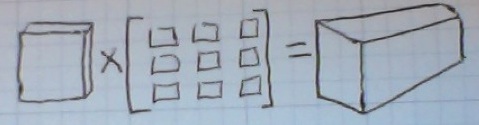
If you think of each point or pixel on the screen as a member of a large array or matrix of vectors (↗: lines with magnitude and direction), then using the rules or theorems of linear algebra you can program all these points to move or change color or take on different shades of grey or even reflect light coming from another point (a.k.a., ray tracing). You can even make one object appear to disappear behind the one in front of it (It’s called “hidden line or object removal”). It’s pretty amazing actually. Suppose one matrix represents an object on your screen, say the eight corners of a cube, and let’s say you throw the cube off a tall building, or at least you want your audience to think it is really being thrown off a building, you can use the laws of physics (classical mechanics) to calculate what a real cube would do as it falls (speed, rotation, trajectory or arc), and then multiply the cube matrix by the speed, rotation, and trajectory pipeline of matrices to get the next frame of the movie, update the pixels on the screen and then repeat the process over and over again forty times per second until the cube hits the ground. But wait, don’t stop there, you can continue the scene as the cube bounces or crushes, or gets stepped on…

Linear Algebra is used in computer graphics, games, chemistry, flying real airplanes, economics, forecasting the weather, data compression (e.g. JPEG), sociology, traffic flow, electrical circuits, and many many other applications.

During my graduate work, and after, I have used Linear Algebra to write my own computer graphics software, develop mechanical systems to reshape complex surfaces, and many other things. When I create using a computer aided design (CAD) application, I understand what the software is doing when I click the mouse or drag a feature from one point to another. When I sit down to a digitally animated movie, I’m a little distracted from the story because “I know how they do it!” I know how they made all those characters move around and do what they do. Linear Algebra is a powerful tool. No tears anymore, just determination. I still don’t have all the rules memorized; but that’s okay, they’re not hidden. I know where to find them.

In graduate school I took linear algebra, finite element method, CAD software development, and utilized these tools in my thesis to research numerical-to-physical surface shape manipulation. I wanted to morph surfaces; surfaces that could be used as forms to shape other objects. I applied for funding and built numerically controlled surfaces (See Engineering Story “The Ribbon Cutting” for a fictionalized story based on my thesis). While the academics were fresh in mind, I took the professional engineering exam to make sure doors of opportunity were always open.

Following graduate school, I worked in industrial automation designing new methods to handle printed circuit boards during production (See fictionalized Engineering Story “Get A Grip”). I also worked as an Engineering Manager during those years. I think the master of science degree was an advantage. Eventually I returned to the aerospace world with modeling and simulation work on guidance, navigation, and control instruments. Along the way I developed my writing skills, a plus that opened more and more opportunities.

I have also looked for opportunities to serve as a mentor to other young engineers; another investment with definite returns. Although not my motive, I was always improved, when I sought to improve and help others. Several stories in this book, for example, are based on experiences gained while coaching and mentoring engineering college seniors.

Such has been my satisfying journey to and through engineering. What will your journey be like?

First Flight for a Child

Have you ever watched small children on their first flight in a commercial aircraft? For those who love children, it is a pleasure. One day, I was departing Austin Texas sitting across the aisle from a small family; two children about five and six years old were seated in the two seats next to the far window, their parents spanned the aisle.

As an aerospace engineer, I love to fly. During various phases of taxi, take-off, and landing, I often imagine what is going on in and around the aircraft from nose to tail, and from tip to tip of each wing. In my mind I review some of the laws of physics applied in the amazing flying machine.

As the pilot engaged the thrust levers and the Boeing 737 accelerated, our seats pushed us forward; the mother of the two children anxiously told them to look out the window. “Now,” she said pointing. “Look out there.”

With faces glued to the window, bodies pulling against their seat belts, each child expressed various forms of thrill and amazement. “Whoa!, Wow, Oh!,…”

At just the right speed, I imagined the pilot pulling back on the control column, the elevators rise, the tail lowering, and the aircraft angle of attack increasing against the main wings. As the nose pitched upward and the wing tips flexed, the earth began to fall away from the plane; their exclamations continued. They wore big smiles as they turned occasionally to acknowledge their experience to their parents.

Shortly we penetrated the clouds and emerged under blue sky, a beautiful sunrise and a soft billowy blanket of clouds below. The joy on their faces brought joy to mine.

Yes, I love engineering. And I also love when it makes people smile.

#engineerclips

Linear Algebra


Linear Algebra Graphic

I was in tears as I left the math building that warm June day. Summer on college campus was relatively quiet, but my mind was clamoring with the noise of theorems and derivations, and proofs drumming away at my confidence. “What have I gotten myself into?” I thought. I had left a good paying job and returned to college after nine years to pursue a master of science degree in mechanical engineering. The very first class I had was Linear Algebra. It was a lot of work re-learning matrices and vectors, moving into linear transformations, determinants, eigenvalues and all their applications. There were times when I didn’t know if I could do it, but I kept at it and looked for ways each day to apply my new knowledge so that it would be interesting and meaningful. Such was the beginning of Linear Algebra for me.

Do you remember the other day when you played a video game, or went to an animated digital movie. How did the movie makers make those complex graphic images look so convincing and real? Perhaps just today you swiped your fingers on a touch pad or touch screen and the photograph you just captured moved or rotated or zoomed at your command. Chances are pretty good that the people who programmed your device used linear algebra or matrix arithmetic to pan, zoom, scale, rotate, or even give depth perspective and reflection to the scene making it look real, like you were really there.

If you think of each point or pixel on the screen as a member of a large array or matrix of vectors (↗: lines with magnitude and direction), then using the rules or theorems of linear algebra you can program all these points to move or change color or take on different shades of grey or even reflect light coming from another point (a.k.a., ray tracing). You can even make one object appear to disappear behind the one in front of it (It’s called “hidden line or object removal”). It’s pretty amazing actually. Suppose one matrix represents an object on your screen, say the eight corners of a cube, and let’s say you throw the cube off a tall building, or at least you want your audience to think it is really being thrown off a building, you can use the laws of physics (classical mechanics) to calculate what a real cube would do as it falls (speed, rotation, trajectory or arc), and then multiply the cube matrix by the speed, rotation, and trajectory pipeline of matrices to get the next frame of the movie, update the pixels on the screen and then repeat the process over and over again forty times per second until the cube hits the ground. But wait, don’t stop there, you can continue the scene as the cube bounces or crushes, or gets stepped on…

Linear Algebra is used in computer graphics, games, chemistry, flying real airplanes, economics, forecasting the weather, data compression (e.g. jpeg), sociology, traffic flow, electrical circuits, and many, many other applications.

During my graduate work, and after, I have used Linear Algebra to write my own computer graphics software, develop mechanical systems to reshape complex surfaces, and many other things. When I create using a computer aided design (CAD) application, I understand what the software is doing when I click the mouse or drag a feature from one point to another. When I sit down to a digitally animated movie, I’m a little distracted from the story because “I know how they do it!” I know how they made all those characters move around and do what they do. Linear Algebra is a powerful tool. No tears anymore, just determination. I still don’t have all the rules memorized; but that’s okay, they’re not hidden. I know where to find them.


My Journey to Engineering – Part 2 “Drafting to Engineering”

(Continued from Part 1)

I was ten and a half years old when Neil Armstrong stepped onto the lunar dust and into the history books. Wow, I thought, looking up that evening at the moon, half illuminated by the setting sun, how amazing is that? My childhood thoughts of “The Man in the Moon” were changed forever.

At my dad’s work back on earth, they manufactured wood panel products with routed or grooved patterns on the panel surface.  They had an automated machine that held the panel upright while a vertical and horizontally moving, 2-axis router would carve a design based on data from a punched tape and tape reader (yes, a punched tape; remember this was the 50’s and 60’s).  On one occasion, they were having trouble getting the plunge axis to work.  This axis would thrust or retract the router blade into or away from the panel.  If the router did not plunge or retract correctly, it would carve where it shouldn’t or it would miss carving where it should.  If this happened, they would have to scrap the panel at some expense.  They invited me, the managers 10-year-old son, to assist the machine by making sure that when it was supposed to plunge, that it did, and that when it was supposed to retract, that it did.  I stood in sawdust close to the machine and watched a light on the computer or tape reader and if the router did not retract, I would grab a bar and pull it out and vice versa.  The workers labeled me, ‘The Automated In and Out.’  Even though faulty, I thought that machine was amazing.

After routing some of their products, they covered them with thin wood-grain vinyl by coating the wood surface with adhesive, then vacuum-applying the plastic to the panels or other furniture (In the 30’s and 40’s, wood-grain vinyl was also used on cars called Woodies).  In some cases this plastic became a hinge for folding mitered panels into a box shape. How ingenious; how clever. Searching the internet, I found an old newspaper article on the company.

I enjoyed math, wood & metal shop, photography, guitar, hiking, skiing, and backpacking. I even used my mom’s sewing machine to make my own backpack from a kit. The backpack was nice, but I was more fascinated with the gears and shafts inside the sewing machine (when my mom wasn’t looking). In shop I made a model sailboat, a footstool, a gavel, a book shelf and a cedar chest. I enjoyed the creative artistic aspects of photo composition as well as chemical development of film and paper. I had a darkroom and equipment for developing black and white film and paper. I took my camera hiking, skiing, and to most activities.

Before the days of portable stereo’s, I built a wooden box and mounted an old 8-Track car stereo inside, with power supply and speakers and took it on outings with friends (No vinyl on this one). I enjoyed basic electrical wiring.

During high school, I took drafting every year.  I enjoyed it; my mechanical pencil was cool.  I enjoyed drawing mechanical objects and architectural structures and renderings.  I thought I was pretty good at it and for a time wanted to become an architect.  Working for my father over the years gave me lots of exposure to drawings, cabinetry, and construction sites; however, as I worked on wood products, I seemed more interested in the machines than in the items being built by them.

At the university I toured campus, talked to professors, and took aptitude tests. I narrowed it down to Communications and Engineering. No one in my immediate family was an engineer but it was drawing me in. Engineering seemed more practical and interesting because I wanted to design mechanisms and machines. I declared my major as Mechanical Engineering. I loved statics, dynamics, and kinematics. I would come home from numerical methods class and program the days learning into my Atari 800 (a personal computer with a whopping 16 kilobytes of RAM memory, no flash memory and no disc drive. I used a magnetic cassette tape to store my programs) I was proud of my accomplishments.

After a little research (before Google and even the internet) I figured out how to reprogram my computers’ joy-stick port for ‘output’ and used it to control a little electric motor I took from an old printer.

During college I continue to work for my dad. He allowed me (with little or no budget) to build a few simple gadgets and machines to help production. While cutting or assembling a thousand drawers for hotel room dressers and night stands, my mind was always on efficiency, “How can this job be done faster and more accurate?” I even explored books on Operations Research and the classical “Cutting Stock” problem so I could write software to help decide how to get the most out of a sheet of plywood.

Yes, I was drafted, no, drawn to engineering and my mind was always solving problems. I enjoyed the challenge and I couldn’t wait to graduate and go to work as a real engineer.

(Go to Part 3)

My Journey to Engineering – Part 1 “Toddling and Tinkering”

“We have to watch him constantly… He takes things apart and puts them back together, turns knobs and pushes buttons, and mimics the other kids…” Such was my mothers account of my first years of life experimenting with my new world, discovering how things work.

I was born at the end of the 1950s in Burbank, California, not too far from Disney Studios.  I was a big boy, being 3 weeks late, I weighed 11 lbs, 8 oz.  I shared the title of ‘new arrival’ with a big Amana upright freezer which was standing by the Christmas tree when mom and I came home from the hospital.  I was a child in the 1960s, a time of amazing drive and development; Apollo, Boeing 747, Supersonic Transport, to name a few. But my world was much smaller at the time.

What characteristics did I exhibit those first few years; where was my interest? My mother continued, “He would move anything that could move. At the age of two, Kenny was such a busy little guy, turning things on and off, like the water taps.” Why did I do this? Was I fascinated with water itself, or just thirsty; did I like to see the water magically appear at the turn of the handle or disappear down the mysterious hole; or was it the sound made as it expelled from the faucet or the predictable motion as it swirled down the drain?

As a minor I learned about material properties. Stingray bicycles were popular with banana seat and high handlebars. I became very proficient riding down our slightly inclined road with no hands. I was demonstrating this skill to my friends one day oblivious to the parked car in my path. I hit the car and received bruises to body and ego.  Like a bowling ball plowing through two remaining pins for a spare, my two handlebars were no match for the kinetic energy of my body; they sheared right off — Did you know that welded soft-metal handlebars are never as good as the original?

And who did the welding? My dad was a handyman, my mom was busy with handicrafts; both were very service minded. My father made cabinets and furniture for a living. I enjoyed visiting his shop, examining the machines and tools, and learning how to read blue-prints (architectural drawings). On occasion dad would take me with him to help him measure a job. I became very comfortable with hammer, measuring tape, and basic carpenter tools. As a cub scout I made a small catapult; when at home, I worked on my tree house. My dad taught me how to work. Thanks Mom and Dad for a great start. Such are the clues that may have steered me toward engineering…

(Part 2 “Drafting to Engineering”)

It’s time for Feedback

My objective in writing Engineering Stories is to encourage students to consider or continue careers in science, technology, engineering, or math (STEM), show what it may be like, dispel a myth or two, and encourage creativity, problem solving, and the confidence to make the world a better place. It is also my hope that teachers will take an interest in using these stories to increase their own understanding of engineering and thus be better able to convey it to students.

As an engineer, I use feedback in determining if a mechanical system is on course; I need the same kind of feedback here. Please reply and let me know the following:

  1. What Engineering Stories did you read?
  2. What did you experience while your read them?
  3. Did the story make you more interested in engineering?
  4. How could the stories be improved to achieve the goal?

Thanks for enjoying Engineering Stories.

Respectfully,

Ken Hardman

A Life, or a Galaxy; Either way, you’ll make a difference

Engineering projects are not all rocket science, but a few are; Engineering designs are not all mathematical, but some are; Engineering teams are not all experts, but many are.

As an engineer, you might create a satellite to measure solar flare radiation headed to earth, or a deep space probe to listen to the stars; or, you might conceive how to help the blind see a sunset, or the deaf hear a symphony.

It may be someone else that develops the optimal trajectory for mankind’s first human trip across the solar system, but it could be you that develops the optimal orthopedic artificial hand making it possible for an amputee to control the trajectory of her own food from hand to mouth across the table.

Either way, you’ll change a life, or the world, or the solar system, or the galaxy, or…

Either way, you’ll make the world a better place.