Engineering Stories Flash Fiction


Since the beginning of this blog two years ago, I have added short stories, short short stories (flash fiction), and riddles. I will add more of each soon. In case you missed any, or joined after they were posted, I have made stories easier to find. The main Engineering Stories home pages includes headings, “Flash Fiction,” and, “Riddles & Poems.” May I invite you to the Flash Fiction tab for some of my short short stories that you can read in a couple minutes. As usual, please recommend my blog to your friends.

https://engineerstories.com/flash-fiction/

Posted in Engineering | Tagged , , , | Leave a comment

Engineering the Quarterback Cam


“Break”

The offense approaches the line. I-formation; running backs in position, 4th down, the Longhorns down by 6, 39 seconds left in the 4th quarter of the 2017 championship game. From the quarterback (QB) cam mounted in the forehead of the quarterbacks helmet, the desparate home team crowd can see what he sees, hear what he hears, and almost feel what he feels; blackened eyes, dirty faces, heavy breathing, grass stained uniforms. The QB takes his place between the guards, looks left, then right, eyes the nose tackle inches away.  The defense shows blitz. The QB calls an audible.

“Hike!”

The linemen hit, the offense fades right as the QB bootlegs behind them, running, looking over his left shoulder, ball tucked. The defense keeps pace. The QB stops, looks cross field to his receiver. The fans see it, he sees it, thousands at home see it, live and on the screen through the cam. The QB and receiver connect, two defensive backs right on the receivers tail. Receiver breaks double coverage dodging right. The defensive cornerback breaks through the line. From every angle all see the sack coming. The QB cocks and releases cross field as his head is twisted by some force, then pounded to the ground as the sound of clashing gear echos through the stadium. The QB cam goes dark in the grass.

Perfect bullet spiral, cross field, just in front of the uprights, just inside the end zone. The receiver launches out, reaching, diving. The pigskin is low, near the ground. Captured a fingers thickness above the grass.

“Incomplete!”

Fans ferociously object, roaring with complant. The offensive coach vehimently stomps onto the field. Thousands of unseen armchair QBs jump in protest spilling drinks on the carpet. The winning team charges the field jumping with joy. The QB lays on the ground. Then a flag is thrown.

“The previous play is under review.”

The QB slowly rises, the QB cam packed with grass and dirt, the image blurry. Fans and players are glued to the screen watching the replays over and over. Impact and GPS readings are displayed over the image. From the QB cam the integrated inertial sensors show violent head twisting following ball release.

“Face mask!” “Face mask!” the offense insist.

The broadcasters switch to the two football (FB) cams mounted forward and aft in each nose of the ball providing clear imagery of the flight of the ball departing the QB (as he’s tackled), sailing over the players, and approaching the receiver, and the ground. The video plays in high definition slow motion as the ball approaches the fingers of the receiver. You can almost see his fingerprints. Is it…? Did he…? The visiting team thinks he did. The FB cam couldn’t lie. As the re-play clearly shows the ball enter the receivers hands while his hands are barely above the grass. The offense cheers, then verbally attack the officials.

While waiting, commentators talk of an earlier year, a different QB and his major in engineering. In addition to leading his football team, he also led a senior engineering project to develop the robust gyrostablized inertial cameras now in regulation use throughout the league. Many objected to the cameras stating that uncertainty was part of the game. But it was inevitable. Fan’s, officials, and players now getting intimate coverage as though they were the QB, as though they were riding inside the ball like pilots in an airplane. The official signals. The crowd goes silent.

“After further review, the call on the field is…..”

#engineerclips

Posted in Engineering | Tagged , , , , | Leave a comment

Engineering Stories Interview in Major Online Magazine


http://eandt.theiet.org/news/2014/oct/engineering-stories.cfm

I was honored to be interviewed by Engineering and Technology Magazine recently regarding my Engineering Stories. Their vision is, “Working to engineer a better world,” and  their Mission is, “To inspire, inform and influence the global engineering community, supporting technology innovation to meet the needs of society.” I hope that my stories can contribute to these objectives. Please click on this link and read the brief article and pass it along to your colleagues and networks.

http://eandt.theiet.org/news/2014/oct/engineering-stories.cfm


Posted in Engineering | Tagged , , , , | 1 Comment

Engineering the Bottle Cap Opener


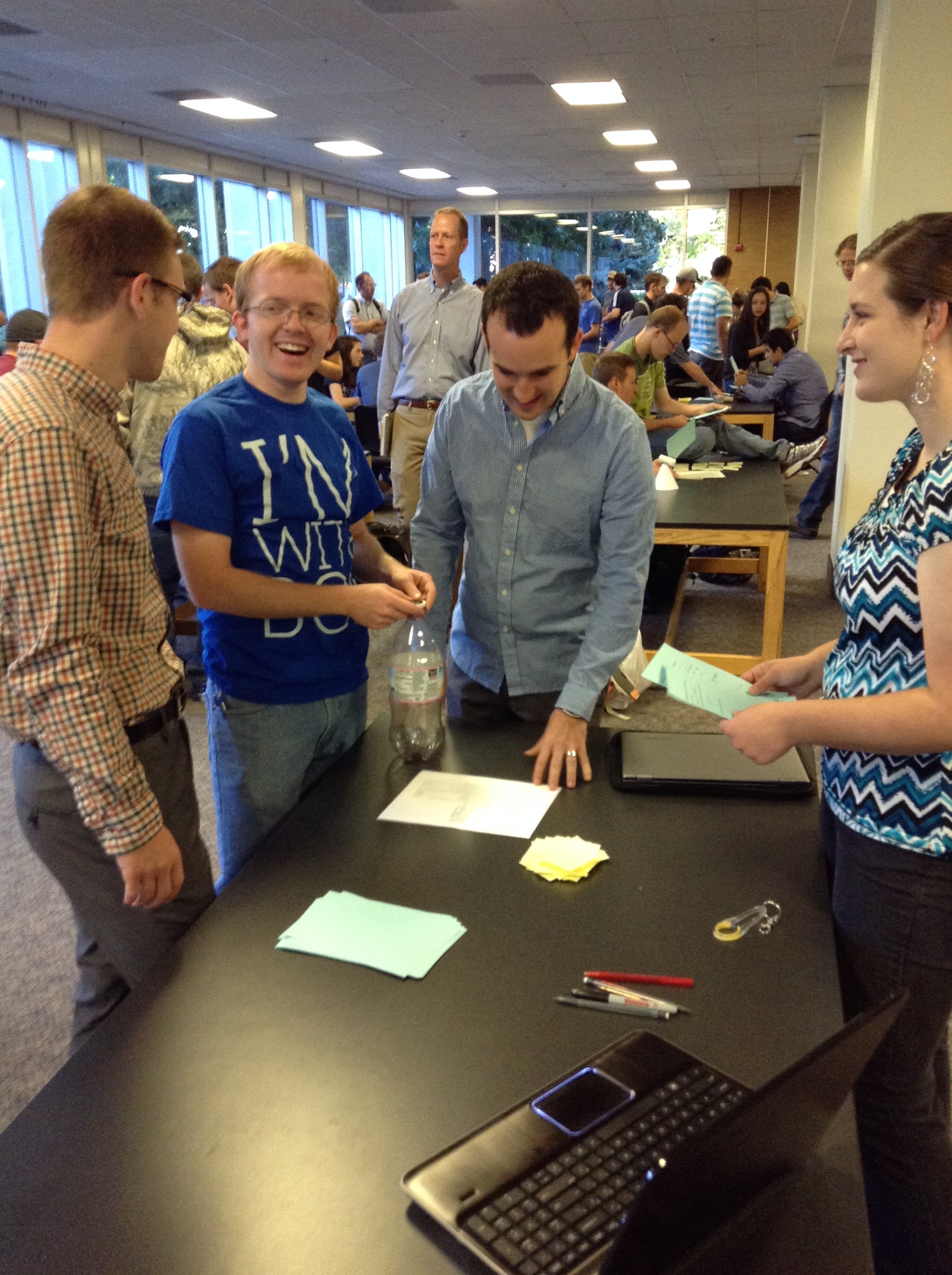
At BYU, the engineering Capstone senior project year is now underway. There are 179 students. The first two weeks included lecture on the fundamentals of product development by Professors Carl Sorensen and Brian Jensen regarding Opportunity Development, Architecture Development, Subsystem Engineering, System Refinement, Producibility Refinement, and Post-Release Refinement. It’s going to be a great year.

During the second week, students were divided into teams of 3 for a one week mini-project; the development of a 2-Liter bottle opener. On Friday we were impressed with the creativity and market thoughtfulness that went into each design. We saw descriptions, sketches, drawings, videos, prototypes of cardboard, paper, plastic, and yes, even 3D printed functional models. Concepts included puncturing spigot devices to extract the drink from the top or the bottom, multi-knob hand cranks with various gripping techniques, and even the riffle shooting lever to open the bottle from a distance. All students and coaches were given 8 post-it notes for multi-voting to go around and evaluate all the concepts. The winner? A sleek key-chain mounted compliant mechanism gripper device complete with video presentation to enhance desirability and transferability.

Congratulations to all BYU Capstone student mini-teams for your great start. Next week, the real teams and the real projects. I repeat; It’s going to be a great year.IMG_1269

Posted in Engineering | Tagged , , , , , , , , | 2 Comments

Desirability and Transferability


I have some great ideas, they’re spinning in my head
They come to me at dawn, while sleeping in my bed
The one I got on Tuesday? a must for every home
The one I got on Wednesday? an app for every phone
I don’t have time for details, nor time to draw a plan
Cause what I got on Thursday? will change the game for man
I had some great ideas, desireable in my head
But since they’re not transferable, my great ideas are dead
Explanation:
In product development and design, in order for a product to be successful, it must be both desirable and transferable. Desirability is determined by the market, the users, the customers. Transferability is the documentation, the drawings, the fabrication instructions that are needed for a production system to make or build the item. Both are essential. This poem is inspired by the new book by Mattson and Sorensen, “Fundamentals of Product Development,” available on Amazon dot com. This text is used in the engineering Capstone class at Brigham Young University.
Posted in Engineering | Tagged , , , | Leave a comment

One + One-half = Four


“Rick?” Becca burst into her colleagues office with her laptop half open. “In the 3D-Printer specification you state that the extruding-head must move precisely to four equally spaced positions.”

Rick let go of his mouse, leaned back and put his finger tips together. “Yah, that’s because there are four filament spools for four polymers. What’s the problem?”

Becca closed and clutched her warm laptop under one arm. “You said the production cost is limited to $50.00 each for the actuator sub-assembly and the electronics. That’s impossible, the stepper motor and driver electronics alone will take more than half that, even if we produce a million of them.”

Rick leaned forward, palms up. “The specification doesn’t require a stepper. Your requirement is to design the machine to move four print-head assemblies, including feed spools to one of four positions, three inches apart, to an accuracy of…”

“I know the resolution, 0.1 millimeters, and that’s going to require either a stepper with gear-head, or servo motor system.”

Rick raised an eye-brow and breathed deep.

“What else is there?” Becca leaned over Rick’s desk. “If there were only two spools, this would be easy, I could just use a solenoid or a pneumatic piston to make the tool change. Whether extended or retracted, the cylinder would stop precisely.”

“You’re trying to do this all by yourself aren’t you?” Becca lowered her shoulders and took a breath thinking, “I knew he’d say something like that. He’s always…”

“Did you consider using two cylinders?” Rick said. “What if you mounted two cylinders end-to-end?”

Becca placed a finger on her chin, lips pressed together, and turned her eyes toward the wall.

Rick leaned back in his chair.

“It wont’ work,” Becca concluded. That will give you three positions, not four.”

“Look, you need to play with some options here. Get together with another perspective, someone who thinks…”

“I know, I know. Someone who thinks a little different.”

Rick folded his arms.” Your too stiff, too binary in your thinking.”

Becca opened her mouth to speak, but nothing emerged. “Binary? What does he mean by that?” She moved her laptop to the other arm, turned, and walked out. “Stiff? Binary?” Becca stopped in the doorway. “Hey. Binary!”

Rick turned his head toward the door. “Becca?”

“Binary,” she repeated as she turned back. “Binary is zero (0) and one (1)…”

“Yes?”

“Not necessarily two zeros, nor two ones.”

“Keep going…” Rick encouraged.

“In a binary system,” she paused, “there are four possible combinations of zero and one.” Becca put her laptop on rick’s desk then went to the whiteboard thinking, “Why do I have the feeling he’s going to be right again?” She wrote, 00, 01, 10, and 11 with a squeaky marker. “Two values, four combinations.”

“Keep going,” Rick said, “But use a different marker, please. How do you get four positions from…”

“From two cylinders?” Becca interrupted. “I got it! Two different sizes! Specifically two cylinders of different strokes.”

Rick stood up and smiled, “But what specific strokes?”

Becca wrote on the board, S(total) = S1 + S2.

“So,” Rick mentored slowly, “what combinations of S1 and S2 will give you…”

“Will give four equal spaces, three inches apart?” Becca drew and populated a table of values for all possible combinations. “Yes! Three and six?”

A relieved smile grew on Ricks face.

She turned and exclaimed, “One three inch, and one six inch cylinder!”

“You see,” Rick said. “I knew you would figure it…”

Becca interrupted, “You knew that all along, didn’t you?”

“No,” Rick rubbed his nose. “It was really you.”

Mentor Discussion and Exercises

Conversation, study, and new perspectives often reveal additional solutions.

  1. Draw and populate the binary table to show four equally spaced lengths given two cylinders of different strokes.
  2. Why didn’t Rick specify the use of cylinders in his specification?
  3. What other methods could be used to achieve cost effective equal spaced actuator positioning?
  4. If mounting two cylinders end to end makes the overall assembly too big, what other cylinder mounting configurations could be used?
  5. Why do 3D Printers often have multiple filament spools?

#engineerclips

Posted in Engineering | Tagged , , , | 1 Comment

Engineering Riddle – No. 6 (Heat Transfer) “I Scale”


I scale in a wind-storm, I scale in a flood
I scale in tornadoes, I scale in the mud
I scale in an oven, the air blistering heat
I scale in a wind-chill, rain, snow or sleet
I scale when it’s calm, or in a twirling spin
I scale with exposure, when gas goes ‘cross the skin
I scale when a flying, I scale in the sky
I scale when a swimming, and even when it’s dry
I scale on the surface, I scale from the wall
I scale whether hot or cold, or whether big or small
I scale several factors, that govern flow of heat
I scale how much energy, will cross the gaseous street
I scale on the surface, from each end of the field
I scale whether hot or cold, my scaling will not yield
I scale in the vapor, when temperatures are different
I scale, yes, that’s all I do; I’m just a coefficient
 
What am I?
 
Posted in Engineering | Tagged , , , | 4 Comments

A Real Engineering Story – Engineering Wheels for Mars


Mission name: Mars Science Laboratory

Vehicle name: Curiosity rover

Problem: Wheels wearing out on sharp rocks of Mars

Solving this problem: Watch this lecture at Jet Propulsion Laboratory (JPL) given recently.

http://www.ustream.tv/nasajpl

Posted in Engineering | Tagged , , , , , , , , | 3 Comments

Engineering Riddle – No. 5 (Fluid Mechanics) “Dimensionless”


I’m a fraction made of forces, comparing different strength
I have no final units, only characteristic length
I sample speed and weight and size, these are the things I measure
My subject as it ebbs and flows, changes shape forever
On top I show inertia, the power to keep things steady
Below I measure thickness, stickiness and eddy
In pipe or duct or channel, o’er wings be smooth, or rough
I’ll tell you dominant motive, whether sheering’s weak or tough
 
What am I?
Posted in Engineering | Tagged , , , , | 2 Comments

Engineering Riddle – No. 4 (Materials) “A Point of No Returning”


Your welcome to disfigure, transform or twist with vigor,
But let me be your warning, to save you dreadful mourning.
When released from deformation, whether tension or compression,
From my left get restoration, from my right, life-long mutation.
I’m a bridge best not for burning, a point of no returning,
Where rifts occur much faster, and cycling meets disaster.
 
What material property am I?
Posted in Engineering | Tagged , , , , , | 5 Comments