
Categories
- Emergency Rescue (1)
- Engineering (68)
- Science Fiction Prototyping (1)
- Stories (6)
-
Recent Posts
- Be a Grass-Roots Leader: A Career Reflection and Invitation
- Rescue on Angels Landing
- Pocket Prototyping
- #EngineerClips – “Drone Vacuum” Jan. 6, 2023
- #EngineerClips – “Power Ski” – March 18, 2022
- Rescue on Angel’s Landing – a near future fictional story by Ken Hardman
- #EngineerClips – “Drawn to Write” – by Ken Hardman (Feb. 27, 2022)
Blog Stats
- 74,496 hits
Archives
-
Join 802 other subscribers
Meta
Engineering Riddle – No. 3 (Physics) “All my strength will be the same”
No matter whether fast or slow, no matter whether high or low, When I return to whence I came, all my strength, will be the same. While traveling round at endless rate, I drop, I rise, I hesitate, But sure enough full strength is brought, when I return to the starting spot. What law do I obey?
Posted in Engineering
Tagged circuit, conservation of energy, electrical engineering, electromotive
2 Comments
Engineering Riddle – No. 2 (Physics) “You push on me, I push right back…”
From in a tube, a fire lit, Great heat and flames, from end emit, The force to make this fluid flow, The same will make the engine go. You push on me, I push right back, You give a blow, I’ll give a smack, What ever your force, there’s none I lack. You push on me, I push right back. When with paddle, a boat you row, What on earth, makes you go? The water and the paddle see, I push on you, you push on me. What am I?
Engineering Riddle – No. 1 (Math) “I may cross once, I may cross twice…”
I may cross once, I may cross twice, I may cross never, but never thrice. When starting up, I finish down, I finish up, when starting down. I have three parts, some friends would say, One straight, one curved, one same all day. With time and place and rate of flight, I’ll tell you where you’ll be tonight. And when you throw a ball up high, I’ll tell you when to close your eye. I’ll use my shape to bend the light, And take you close to stars at night, And if you want to talk to friends, Transmit/Receive, I’m on both ends. Now if my name you still can’t state, Just draw a line, then integrate. What am I?
The Orbital Mechanic in STEM Magazine
I am pleased that one of my stories, “The Orbital Mechanic” was published in STEM Magazine and will be available to a large educator audience. The story is in two parts: May and June Issues
Click to access 514513revised.pdf
Click to access STEMJune14.pdf
Pre-Engineering Program with Awesome Students
“Mr. Hardman, have you ever been to space?” one student asked.
“Would it be possible to use an evacuated tube to get to space?” another student asked.
“Could the Earth be used for a gravity assist to get to Mars?” another asked.
Such were the questions during my presentation to 75 7th graders at the Utah Valley University (UVU) Pre-freshman Engineering Program (PREP) held each summer in Utah. This was my second year speaking to them and they were great in their knowledge of physics, math, curiosity, respect,…
I spoke about my various career opportunities in engineering, we watched a couple videos on the development of aircraft and spacecraft, we talked about the good that engineers can do to make life better for people, and we had fun acting-out some physics. To demonstrate the sling-shot or gravity assist principle to get spacecraft to the outer solar-system, several students came to the podium, one representing the sun, one representing Earth, another was Mars, another was Venus, and another was a space probe. I put them into their orbits and they understood that planets closer to the sun orbited faster and planets farther out orbited slower. I launched a student or probe from Earth, she fell toward the sun and came in behind Venus gaining energy and speed then flinging out toward Mars. It was exciting and fun.
We talked about all kinds of physics associated with aerospace and astro-space – they were smart kids selected to represent their school districts in the intense pre-engineering summer program. At the end, a few of the kids came up and asked some pretty smart questions. What a privilege to interact with them. They will now go back to their schools and mentor others.
Yes! there are kids being prepared to be the engineering problem solvers of the future.
“How does your digital device know to rotate the text when you rotate your digital device (e.g. iPhone),” I asked?
“Accelerometers!”
“You know what accelerometers are?” I asked. They did, and we talked about them. Great kids, great questions, great future for them and for us.
http://www.uvu.edu/partnership/programs/prep.html
The Minor in Engineering – Wireless
“Grandpa?” 5 year-old Ben eagerly grabbed me one holiday, while the other kids played soccer.
“Yes Ben?” I replied, looking down at the blond bundle of thought.
Ben hesitated then found the right words. “How does electricity move without wires?”
His mother gave a familiar nod as such curious tenacity was routine.
“Well Ben,” I said not knowing what I’d say next. “When electricity flows in a wire, it…”
“No,” Ben asserted. “Not in a wire; without wires!”
Ben locked eyes with mine, one hand gripping a double-a battery, the other a Lego(R) creation with levers and cranks.
Experience told me it was time for an illustration.
“Let’s get paper and pencil.”
Off he went and returned quickly.
“Okay.” I drew a simple image of a battery, which he recognized from prior engineering collaboration. Then I drew a line representing a wire, a switch, and a light bulb all in one circuit loop.
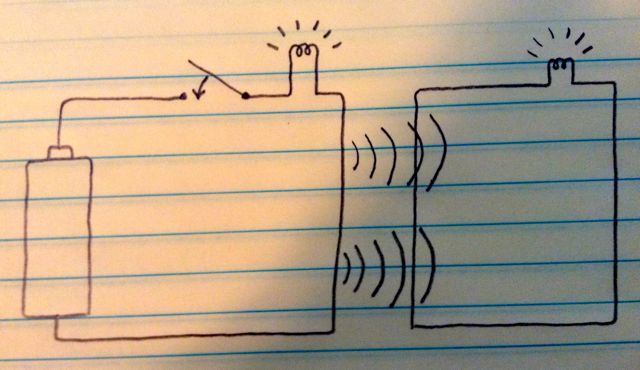
“Remember this?” I pointed at the break in the circuit. “When you close this switch, the electricity flows throught the wire, through the light, and makes it glow.”
“I know grandpa, but what about…”
“Okay,” I interupted while moving my finger around the loop.
Ben followed carefully.
“When electricity, or charge, flows through a wire,” I continued, “it creates an invisible magnetic field around the wire.”
Ben studied my face again, his jaw dropped a little. “A magnetic field?”
“Or a force. If I open and close this switch again and again, it will create magnetic waves moving out away from the wire.”
I drew a similar nearby circuit with a smaller light, no switch, no battery, just a wire loop with small light.
“Now Ben, when you open and close this switch on the first circuit, it creates magnetic waves that go over to the other circuit, like the waves on the beach.”
I drew a series of arcs radiating across the paper.
“When the waves hit the new wire, it forces electricity to flow in the wire, and if the new circuit is sensitive enough, that electricity can be used to signal, or turn other things on and off.”
Ben looked at me, then at the paper, then at me again. I could almost hear the gears turning in his brain, or in this case, electrons orbiting his central processor.
“Let’s do it grandpa,” as he darted for his dad’s toolbox, “with real wire and batteries.”
“But don’t you want to play soccer?”
“No!” he said without explanation. “Let’s build a remote control.” He held up his Lego(R) machine, eyes as wide as the moon.
Posted in Engineering
Tagged antenna, charge, electricity, electromagnetism, magnetic field, mentor, wireless
Leave a comment
NASA Tech Briefs really do say something about Underwear
“Dad, can I come in?” Jenni knocked on the door of her dad’s home office.
“What’s up, Jenni?”
“Well, I was just looking at the magazines on the coffee table, and…”
“And what?”
“I was wondering,” Jenni said slowly. “Does NASA sell underwear?”
“Where did you get an idea like that?”
Jenni pulled a magazine from behind her back. “What are NASA Tech Briefs? Is this a clothing catalog for astronauts?”
Jenni’s dad laughed. “No, ‘briefs’ means ‘shorts…’ I mean, not short pants but short reports or briefings regarding NASA research.”
Jenni nodded. “Oh! I thought…”
“However,” Jenni’s dad interrupted. “NASA develops many technologies that are available to the public. It wouldn’t surprise me if there was something in NASA Tech Briefs about astronaut clothing. Let’s search and find out.”
Jenni and her father searched the NASA Tech Briefs website for underwear.
“Sure enough,” Jenni’s dad said. “Here’s one. Spacesuit Materials Add Comfort to Undergarments. Let’s see what this is all about.”
“Okay dad.”
http://www.techbriefs.com/spinoff/117-consumer-home-and-recreation/17413-spacesuit-materials-add-comfort-to-undergarments-53981135
Posted in Engineering
Tagged astronaut, materials, NASA, Space, space clothing, space suit, thermal underwear
1 Comment
Update from the Author
Dear Engineering Stories followers,
I hope you’re all aware by now that my series of eight stories are available for free in a variety of ebook formats. Spread the word and encourage youth and engineering students to read Engineering Stories.
Of late I have had the need and opportunity to use some engineering and math academics at work in understanding and analyzing control systems. Yep, if any of you have taken Controls Engineering, or Linear Systems classes, you’ll know what I’m talking about; Newtons laws, Kirchhoffs laws, free body diagrams, Laplace Transforms, control diagram reductions, stability analysis,… This may be crazy, but I am enjoying using such science to accomplish good things. I’m one of those college students that kept most of my text books, and am I glad I did. Of course, if I can’t find what I need in my dusty text’s, then I can go on-line or email my professors from way back.
Anyway, I like re-learning what I once knew, or thought I knew. Dynamic Systems and transfer functions; good stuff, powerful tools. What engineering academics have you used lately?
Ken
Posted in Engineering
Tagged Free Body Diagrams, Laplace Transform, mathematics, Transfer Function
3 Comments
Mars Mission Case Study from
May I recommend this interesting Aerospace Engineering case study presented partly in story form. It comes from the National Center for Case Study Teaching in Science, University of Buffalo, and the National Science Foundation.
“The Mars Climate Orbiter was deployed by NASA as part of a mission to study weather and climate on Mars. It was supposed to enter orbit at an altitude of 140.5–150 km (460,000-500,000 ft) above Mars, but due to an error, the space…”
http://sciencecases.lib.buffalo.edu/cs/collection/detail.asp?case_id=418&id=418
Posted in Engineering
Tagged Case Study, case study teaching, Mars, Mars Weather Orbiter, orbit insertion, Problem Solving, university of buffalo
1 Comment
 Engineer Stories