ENGAGE Everyday Examples of Engineering Lesson Plans


They’re not Engineering Stories, but they’re detailed lesson plans being created and used by educators to help students see, feel, and understand engineering, improving STEM teaching in the classroom.

It’s called

Engage – Everyday Examples in Engineering

If you love a good Engineering story-problem, don’t wait until the classroom, take a look at these lessons right now. For example, click on Statics and see how engineering skills of Beam Bending, Bending Moments, and Shear Stress Diagrams can be used to model and analyze the deflections of a skateboard and other planks.

I’ve added the Engage link to my Recommended Links page.

https://stemstories.wordpress.com/recommended-links/

Posted in Engineering | Tagged , , , | 2 Comments

Tunnel Vision Part III


The terminal and smells of hydraulics and motors are now well behind us and the status console indicates NORMAL operating conditions. It is no longer possible to look at the tube structural support rings as they pass at a rate faster than the flapping of hummingbird wings.

As the tube slowly turns to go around and through mountains, the pod rotates like a banking roller coaster keeping our sense of gravity directed down through our seats.

The on-board stereo is softly playing the soundtrack from a popular science fiction space trek show and my mind links up with a scene from an episode where the space ship is propelled to a distant part of the galaxy by mental control of thought, time, and energy. I am awakened from this brief daydream by a yellow WARNING sign above each seat and a soft professional automated voice instructing passengers to place their heads against the head rest for the upcoming increase in acceleration.

Just moments ahead is the greatest design challenge of the whole system: analysis of the geometric, thermal, and dynamic parameters of the wind tunnel throat such that this high volume of air will indeed transition from subsonic to supersonic speeds as the tunnel re-expands. While reflecting on the many details studied during the design phase, my mind wanders for an instant to the many potential applications to use this mode of high speed transportation. A ski lift in the Wasatch mountains, underwater transoceanic links from San Francisco to China, satellite launchers, postal payload and letter delivery networks, and large scale, 100 plus passenger models, like a commercial aircraft or train fuselage with no wings, tail, or landing gear. My reflection is interrupted by a subtle vibration caused by a shock wave forming on the leading edges of the pod…

Posted in Stories | Tagged , , , , , | Leave a comment

Tunnel Vision Part II


Just before stepping through the hatch of our five foot diameter bullet, I look behind the craft at the 165 foot diameter fan stretching above and all around me and I realize more than I had ever before, that I would be sharing space with this huge mass of turbulent energy as we both accelerate into the common 5 foot diameter tunnel just ahead. Although invisible, I could feel the airstream converging in on itself, and me, creating a pressure difference across the pod.

We take our seats, which are highly reclined to minimize the pod and tunnel diameter, and fasten our seat belts for the non-stop trip. This is no ordinary craft. There are no wheels, no bearings, no engine, and no brakes. This pod is a pressure vessel with forward and aft regulators to balance the inside environment at a comfortable pressure, temperature and air circulation. Forward and aft circumferential hydrodynamic seals turn the cylinder into a piston, a very fast piston, driven at cruse by pneumatic pressure.

As the hatch is closed, I sit uneasy. I look out through the mostly transparent tubular walls at those who we leave behind and it occurs to me that in a moment, they will be many, many miles away. My eyes scan from the right, over head and to my left, taking in the exciting moment, and then after a brief wink at each member of my family, I look straight ahead and become acutely aware of the small  hole which is to be our immediate destination. The ALL CLEAR indicator illuminates on the front console, a small bump sounds from below, and we move out at a brisk 1/2 the acceleration of gravity, 15 ft/sec2.

v = a*t

x =  ½ a*t^2

(constant acceleration equations with zero initial velocity and position)

At this rate we reach 100 miles per hour in 10 seconds (not exactly a drag race car), having traveled a quarter mile. After 20 seconds, we pass 200 miles per hour and just over one mile. This constant acceleration continues as the air behind us converges and we approach the throat, minimum tunnel diameter, and 640 miles per hour…

#engineerclips

Posted in Stories | Tagged , , , , , , , , | Leave a comment

Tunnel Vision Part I


(Here is a short short story I wrote many years ago, for your engineering imagination, vision, and assessment. Is this story possible? Can such a wind tunnel really be operated? If not, why? Does it violate some law of physics or thermodynamics? What are the challenging design issues? What are the environment and safety issues? I look forward to your comments.)

Tunnel Vision – Part I

Here I am, finally, standing in the entrance of a life-long dream, ready to climb aboard a four-seat cylindrical pod and fly through a 600 mile long wind tunnel at speeds approaching Mach 3. It is a beautiful spring morning here in Salt Lake City, Utah. The sun has just risen over the Great Salt Lake, and in 15 minutes, my family and I will be in Anaheim, California, to see it rise again, this time over the Pacific Ocean. We plan to enjoy two full days at our favorite theme park before returning home having missed only two days of work.

As we enter the terminal, to my left are the huge turbo-fans providing the large mass-flow-rate of air to the slowly converging tunnel stretching to the right. My heart accelerates as I witness the party ahead of us enter their pod, secure themselves and their belongings, and look forward down the launch rails in anticipation.

Upon positive detection of all enable circuits, the pod’s onboard computer engages its drive cam with the variable lead, threaded shaft rotating at constant angular velocity and extending a mile into the tunnel. The pod in front of us moves out at a moderate, but aggressive constant acceleration and in a matter of 10 seconds is out of sight.

For a moment, my mind jumps back to a time when I was a child and I went with my mother to the drive-up window at the bank. She put a check or some money in a small plastic canister, placed it in a machine outside the car window, pushed a button, and after 3 seconds and a vacuum like sound, the canister was in the hands of the teller in a nearby building. Oh how fun, I thought, to go on such a ride.

Then it was our turn. We stepped into the airfoil shaped bridge protecting us from the high winds. From here I could see clearly the variable-lead screw drive shaft just below our pod. Its threaded helix was designed with an initial small gradual angle thus importing a small forward velocity to any vehicle engaged to it. This design concept provides for continuous, unchanging operation, fewer moving parts, and less start and stop action. The acceleration of the engaged pod is directly proportional to the rate-of-change of the helix angle with respect to distance along the shaft. The angle increases steadily until at its high helix end, the pods velocity will be approaching Mach point three (0.3).

Just before stepping through the hatch…

(Click Part II below) #engineerclips

Posted in Stories | Tagged , , , , , , | Leave a comment

What do Engineers Do? Look at their Senior Projects


Want a good idea of what engineers do? Take a look at thousands of Engineering Senior Projects.
http://www.cefns.nau.edu/interdisciplinary/d4p/
http://www.ce.ucsb.edu/undergrad/sr-projects/
http://www.mtu.edu/mechanical/undergraduate/senior-design/
http://umaine.edu/mecheng/senior-design-projects/
http://www.bu.edu/ece/undergraduate/senior-design-project/
http://eeic.osu.edu/capstone/capstone-design-showcase
http://eecs.oregonstate.edu/node/292
http://digitalcommons.calpoly.edu/mesp/
http://mechanicalengineering.pages.tcnj.edu/academic-programs/me-senior-projects/
many many more
search the internet for mechanical engineering senior projects

Posted in Engineering | Tagged , , , , , , | Leave a comment

Announcement – Engineering Stories in Paperback


Engineering Stories is now in paperback! Seven stories illustrated, formatted, and published in a handsome professionally bound book for some ernest reading. Listen to these endorsements by engineering academic professionals on the back cover.

“A fabulous collection of realistic engineering adventure stories! Ken Hardman connects the design and development process we teach in engineering school to the exciting challenges faced every day in real engineering practice.” Steven D. Eppinger, Professor of Engineering Systems at MIT, co-author Product Design and Development

“Ken Hardman’s stories about engineering are a joy to read. In them he captures the excitement of engineers developing solutions to realistic technical problems. By describing the engineering process through fictional characters in fictional settings, Hardman invites the reader to participate in the adventure of invention and discovery.” Henry Petroski, A.S. Vesic Professor of Civil Engineering, Duke University, and author of, among other books, To Engineer Is Human, To Forgive Design, and An Engineer’s Alphabet.

Engineering Stories are for:

  • The high school student who wonders if engineering is for them,
  • The K12 career counselor or teacher who needs more depth in explaining engineering to students,
  • The parent or grandparent or friend who would like to encourage a youth toward a satisfying, useful, and profitable career,
  • The college engineering freshman who is deciding what major to declare,
  • The older college engineering student who cries for ways to apply their engineering academics, anxious to experience real engineering, real companies, and real teams, and
  • The young engineering professional who wants to live the engineering experiences of there peers, gaining encouragement and insight to move forward in their career.

“Ken Hardman has done a masterful job—even spellbinding—in depicting what real Science, Technology, Engineering, and Math (STEM) projects, and the people and circumstances involved in them, are actually like in the real world! Having myself been involved for more than fifty years in the types of projects that Ken writes about—and the use of case studies in engineering education for more than forty years—I can say without equivocation that Ken’s case writing ability is superb! Page after page challenges you to use your creative juices, and you feel as if you are right in the lab, conference room—or wherever—huddled around some hardware as part of a team effort working through the technical, as well as the people issues, to get the problem solved! Each engineering story has been carefully chosen to share important skills, topics and essential abilities of great engineers and scientists at work! These stories will help you experience—just about as close to first hand as possible—the joys of creation and problem solving which result from learning and applying skills in a world where all of us have the opportunity to make things better.” Robert H. Todd, PhD, P.E., Fellow of The American Society of Engineering Education, Professor Emeritus Department of Mechanical Engineering Brigham Young University

Engineering Stories has boiled down the relationship between an engineering education and real-world engineering situations to its core! I know of no better introduction for engineering students preparing to work in industry. Anybody seriously considering a career in engineering will benefit from and enjoy reading Engineering Stories!” Braden Hancock, Mechanical Engineering Student at Brigham Young University, ASME 2012 Kenneth Andrew Roe Scholarship recipient

(If you are not inclined to acquire the paperback, continue to enjoy the same individual stories that are available for free at the authors website. Whether online or paperback, discover the career of engineering through Engineering Stories.)

http://www.amazon.com/Engineering-Stories-Realistic-Fiction-STEM/dp/1483949869

Posted in Engineering | Tagged , , , , , , , , , , , , , , | Leave a comment

Have fun engineering with your family


“Hey grandpa,” Grandson said, “let’s play marble track.”
“Hey grandson,” engineer Grandpa said, “let’s be engineers today and invent our own marble track. We can learn about engineering, science, and kinetic energy.”
“Yes!” grandson responded.
So grandpa and grandson went to the hardware store and office supply and found parts for a custom marble track. They used 1/2 x 1/2 inch aluminum angle, adhesive-backed magnetic tape, plastic electrical flange (blue) cut into quarters and halfs, a modified funnel, and a metal backed dry-erase white board. They went home and cut the parts (safely), applied the magnetic tape to the parts, and created their own marble track. The configurations were endless. See the video here.

Science, Technology, Engineering, and Math (STEM) can be fun. Try this project and learn about kinetic energy and momentum.
(A short short story from the author of Engineering Stories)
https://stemstories.wordpress.com

Posted in Engineering | Tagged , , | 3 Comments

My Journey to Engineering – Part 3 “From College to Industry”


(Continued from Part 2)

“What are these photo’s you brought?” The interviewer asked during my senior year at the university. I was applying for my first engineering job and I brought pictures of the devices I had made for my dad’s cabinet shop. I think it was the photo’s that convinced the interviewer that I had good practical hand’s on engineering experience. I got the job. We packed up our little household and moved to California, or should I say ‘returned to California,’ the place of my birth.

My assignment? Design and test supporting structures for satellite payloads. Requirements? High strength to weight ratio’s with high reliability. I learned about space environments, material properties, computer aided design systems, and how aerospace companies work.

After a couple years I became a test engineer, then system safety analyst, then electronics packaging designer, then… Each assignment gave me experience in new areas of engineering. I tried diligently to learn company goals and objectives and participate in process improvement initiatives. This focus brought trust and new opportunities to serve and grow. But I wasn’t finished with school yet. I wanted a masters degree and I wanted to continue my education; I loved to learn.

I applied for graduate school, was accepted and returned to the university. I was in tears as I left the math building that warm June day. Summer on college campus was relatively quiet, but my mind was clamoring with the noise of theorems and derivations, and proofs drumming away at my confidence. “What have I gotten myself into?” I thought. I had left a good paying job and returned to college after nine years to pursue a master of science degree in mechanical engineering. The very first class I had was Linear Algebra. It was a lot of work relearning matrices and vectors, moving into linear transformations, determinants, eigenvalues and all their applications. There were times when I didn’t know if I could do it, but I kept at it and looked for ways each day to apply my new knowledge so that it would be interesting and meaningful. How meaningful could linear algebra be?

Do you remember the other day when you played a video game, or went to an animated digital movie. How did the movie makers make those complex graphic images look so convincing and real? Perhaps just today you swiped your fingers on a touch pad or touch screen and the photograph you just captured moved or rotated or zoomed at your command. Chances are pretty good that the people who programmed your device used linear algebra or matrix arithmetic to pan, zoom, scale, rotate, or even give depth perspective and reflection to the scene making it look real, like you were really there.

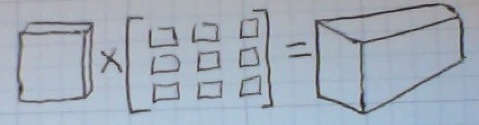
If you think of each point or pixel on the screen as a member of a large array or matrix of vectors (↗: lines with magnitude and direction), then using the rules or theorems of linear algebra you can program all these points to move or change color or take on different shades of grey or even reflect light coming from another point (a.k.a., ray tracing). You can even make one object appear to disappear behind the one in front of it (It’s called “hidden line or object removal”). It’s pretty amazing actually. Suppose one matrix represents an object on your screen, say the eight corners of a cube, and let’s say you throw the cube off a tall building, or at least you want your audience to think it is really being thrown off a building, you can use the laws of physics (classical mechanics) to calculate what a real cube would do as it falls (speed, rotation, trajectory or arc), and then multiply the cube matrix by the speed, rotation, and trajectory pipeline of matrices to get the next frame of the movie, update the pixels on the screen and then repeat the process over and over again forty times per second until the cube hits the ground. But wait, don’t stop there, you can continue the scene as the cube bounces or crushes, or gets stepped on…

Linear Algebra is used in computer graphics, games, chemistry, flying real airplanes, economics, forecasting the weather, data compression (e.g. JPEG), sociology, traffic flow, electrical circuits, and many many other applications.

During my graduate work, and after, I have used Linear Algebra to write my own computer graphics software, develop mechanical systems to reshape complex surfaces, and many other things. When I create using a computer aided design (CAD) application, I understand what the software is doing when I click the mouse or drag a feature from one point to another. When I sit down to a digitally animated movie, I’m a little distracted from the story because “I know how they do it!” I know how they made all those characters move around and do what they do. Linear Algebra is a powerful tool. No tears anymore, just determination. I still don’t have all the rules memorized; but that’s okay, they’re not hidden. I know where to find them.

In graduate school I took linear algebra, finite element method, CAD software development, and utilized these tools in my thesis to research numerical-to-physical surface shape manipulation. I wanted to morph surfaces; surfaces that could be used as forms to shape other objects. I applied for funding and built numerically controlled surfaces (See Engineering Story “The Ribbon Cutting” for a fictionalized story based on my thesis). While the academics were fresh in mind, I took the professional engineering exam to make sure doors of opportunity were always open.

Following graduate school, I worked in industrial automation designing new methods to handle printed circuit boards during production (See fictionalized Engineering Story “Get A Grip”). I also worked as an Engineering Manager during those years. I think the master of science degree was an advantage. Eventually I returned to the aerospace world with modeling and simulation work on guidance, navigation, and control instruments. Along the way I developed my writing skills, a plus that opened more and more opportunities.

I have also looked for opportunities to serve as a mentor to other young engineers; another investment with definite returns. Although not my motive, I was always improved, when I sought to improve and help others. Several stories in this book, for example, are based on experiences gained while coaching and mentoring engineering college seniors.

Such has been my satisfying journey to and through engineering. What will your journey be like?

Posted in Engineering | Tagged , , , , , , , , , , , | 1 Comment

First Flight for a Child


Have you ever watched small children on their first flight in a commercial aircraft? For those who love children, it is a pleasure. One day, I was departing Austin Texas sitting across the aisle from a small family; two children about five and six years old were seated in the two seats next to the far window, their parents spanned the aisle.

As an aerospace engineer, I love to fly. During various phases of taxi, take-off, and landing, I often imagine what is going on in and around the aircraft from nose to tail, and from tip to tip of each wing. In my mind I review some of the laws of physics applied in the amazing flying machine.

As the pilot engaged the thrust levers and the Boeing 737 accelerated, our seats pushed us forward; the mother of the two children anxiously told them to look out the window. “Now,” she said pointing. “Look out there.”

With faces glued to the window, bodies pulling against their seat belts, each child expressed various forms of thrill and amazement. “Whoa!, Wow, Oh!,…”

At just the right speed, I imagined the pilot pulling back on the control column, the elevators rise, the tail lowering, and the aircraft angle of attack increasing against the main wings. As the nose pitched upward and the wing tips flexed, the earth began to fall away from the plane; their exclamations continued. They wore big smiles as they turned occasionally to acknowledge their experience to their parents.

Shortly we penetrated the clouds and emerged under blue sky, a beautiful sunrise and a soft billowy blanket of clouds below. The joy on their faces brought joy to mine.

Yes, I love engineering. And I also love when it makes people smile.

#engineerclips

Posted in Engineering | Leave a comment

Linear Algebra


Linear Algebra Graphic

I was in tears as I left the math building that warm June day. Summer on college campus was relatively quiet, but my mind was clamoring with the noise of theorems and derivations, and proofs drumming away at my confidence. “What have I gotten myself into?” I thought. I had left a good paying job and returned to college after nine years to pursue a master of science degree in mechanical engineering. The very first class I had was Linear Algebra. It was a lot of work re-learning matrices and vectors, moving into linear transformations, determinants, eigenvalues and all their applications. There were times when I didn’t know if I could do it, but I kept at it and looked for ways each day to apply my new knowledge so that it would be interesting and meaningful. Such was the beginning of Linear Algebra for me.

Do you remember the other day when you played a video game, or went to an animated digital movie. How did the movie makers make those complex graphic images look so convincing and real? Perhaps just today you swiped your fingers on a touch pad or touch screen and the photograph you just captured moved or rotated or zoomed at your command. Chances are pretty good that the people who programmed your device used linear algebra or matrix arithmetic to pan, zoom, scale, rotate, or even give depth perspective and reflection to the scene making it look real, like you were really there.

If you think of each point or pixel on the screen as a member of a large array or matrix of vectors (↗: lines with magnitude and direction), then using the rules or theorems of linear algebra you can program all these points to move or change color or take on different shades of grey or even reflect light coming from another point (a.k.a., ray tracing). You can even make one object appear to disappear behind the one in front of it (It’s called “hidden line or object removal”). It’s pretty amazing actually. Suppose one matrix represents an object on your screen, say the eight corners of a cube, and let’s say you throw the cube off a tall building, or at least you want your audience to think it is really being thrown off a building, you can use the laws of physics (classical mechanics) to calculate what a real cube would do as it falls (speed, rotation, trajectory or arc), and then multiply the cube matrix by the speed, rotation, and trajectory pipeline of matrices to get the next frame of the movie, update the pixels on the screen and then repeat the process over and over again forty times per second until the cube hits the ground. But wait, don’t stop there, you can continue the scene as the cube bounces or crushes, or gets stepped on…

Linear Algebra is used in computer graphics, games, chemistry, flying real airplanes, economics, forecasting the weather, data compression (e.g. jpeg), sociology, traffic flow, electrical circuits, and many, many other applications.

During my graduate work, and after, I have used Linear Algebra to write my own computer graphics software, develop mechanical systems to reshape complex surfaces, and many other things. When I create using a computer aided design (CAD) application, I understand what the software is doing when I click the mouse or drag a feature from one point to another. When I sit down to a digitally animated movie, I’m a little distracted from the story because “I know how they do it!” I know how they made all those characters move around and do what they do. Linear Algebra is a powerful tool. No tears anymore, just determination. I still don’t have all the rules memorized; but that’s okay, they’re not hidden. I know where to find them.


Posted in Engineering | Tagged , , , , , | 1 Comment